
What Is a Hybrid Energy Storage System?

Hybrid Energy Storage Systems combine two or more storage technologies within one coordinated power solution. Common pairings include lithium-ion batteries with supercapacitors, flow batteries, or thermal storage. Each technology handles a different task. Batteries provide sustained energy. Supercapacitors answer sudden power demands.

This arrangement can improve response speed, operating life, and system flexibility. For example, a battery may supply electricity during a two-hour peak period, while a supercapacitor absorbs a sharp load from industrial equipment. A smart energy management system controls these exchanges. It monitors voltage, temperature, state of charge, and forecast demand. Good control matters as much as hardware.

Real projects still require careful engineering. Hybrid Energy Storage Systems are not automatically cheaper, safer, or more efficient. Results depend on duty cycles, local climate, grid rules, maintenance skills, and component compatibility. A coastal microgrid may need corrosion protection, while a solar farm may prioritize evening energy delivery. These details can change the design completely.

From an engineering perspective, the strongest assessment compares lifetime cost, round-trip efficiency, degradation, safety margins, and response time. Field data should support every major claim. Laboratory performance alone can mislead. In practice, engineers may find impressive specifications weakened by cooling limits or control delays after repeated cycling. That weakness deserves attention. It encourages better testing.

This guide explains how hybrid storage architectures work, where they create practical value, and which trade-offs deserve attention. The goal is not to promote one technology. It is to support informed, evidence-based decisions. Some designs will remain imperfect. That is normal. Reliable planning begins by recognizing those limits.
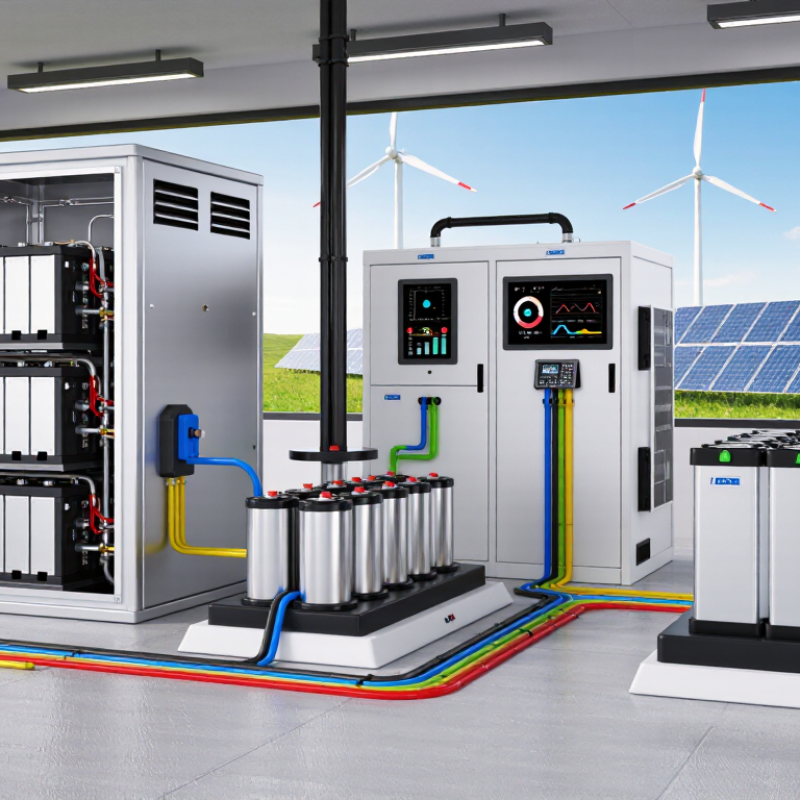
What Is a Hybrid Energy Storage System?

Definition and Core Principles of a Hybrid Energy Storage System

What Is a Hybrid Energy Storage System?

A hybrid energy storage system combines two or more storage technologies with different strengths. A battery may provide sustained energy, while a supercapacitor handles sudden power surges. Other combinations may include batteries with flywheels, thermal storage, pumped storage, or hydrogen systems. The core principle is complementarity, not simple addition.

The system controller assigns each task to the most suitable device. During a factory motor start, the high-power unit responds within milliseconds. The battery then supplies steadier energy for hours. Sensors track voltage, temperature, state of charge, and power demand continuously. This coordination can reduce battery stress and improve usable system life. However, the result depends heavily on control quality.

The International Energy Agency reported that global battery storage capacity may need to reach about 1,200 GW by 2030 in a net-zero pathway. That pressure makes efficient system design increasingly important. The National Renewable Energy Laboratory reports typical utility-scale battery round-trip efficiency near 85–95%, depending on configuration. Hybrid systems may improve performance, but they also add interfaces, maintenance needs, and failure points. More equipment does not guarantee more resilience.

A practical design begins with the load profile. A rural microgrid might use batteries for evening demand and fast-response storage for cloud-driven solar fluctuations. Engineers must also examine fire protection, thermal limits, replacement schedules, and degradation.

The neat diagram can hide costly assumptions. Sometimes, a simpler system performs better.

Key Components and How They Work Together

A hybrid energy storage system combines storage technologies with different strengths. Lithium-based batteries usually provide sustained energy for hours. Supercapacitors or flywheels respond faster, often within milliseconds. Batteries are the marathon runners. Fast-response devices handle sudden power changes, such as motor starts or rapid load shifts. This pairing can reduce battery stress and improve operating life, although real results depend on temperature, cycling patterns, and control settings.

The power conversion system connects each storage unit to a shared DC bus or AC network. Bidirectional converters regulate charging and discharging in both directions. An energy management system reads demand, electricity prices, state of charge, and renewable output. It then assigns short spikes to the fast device and longer energy needs to the battery. A battery management system monitors cell voltage, temperature, current, and imbalance. Sensors and protective relays can isolate faults before damage spreads. Thermal management matters too. A warm battery may accept less current than expected.

In field testing, coordination is rarely perfect. A controller may protect the battery well but waste available renewable energy. Engineers must adjust thresholds using measured data, not assumptions. Maintenance teams should inspect connections, cooling paths, alarms, and communication links. Small timing errors can create unnecessary conversion losses. Safety remains a design task, not an afterthought.

What Is a Hybrid Energy Storage System? - Key Components and How They Work Together
System Element Typical Technology or Data Primary Function How It Works with Other Components Typical Operating Characteristics
Energy Storage Unit Lithium-ion battery Flow battery Lead-acid battery Stores electrical energy for longer-duration discharge and supplies sustained power to the load. Receives controlled current from the power conversion system and works with the high-power storage unit to balance energy capacity and response speed. Minutes to several hours of discharge, depending on capacity, state of charge, and system design.
High-Power Storage Unit Supercapacitor Flywheel High-power battery Handles rapid changes in power demand, short-duration peaks, and transient events. Responds faster than the energy-oriented storage unit, reducing sudden current changes and limiting stress on the main battery. Milliseconds to minutes of response or discharge, with high power capability and frequent cycling suitability.
Bidirectional Power Converter DC/DC converter Bidirectional inverter Converts voltage and current between storage devices, the direct-current bus, and the alternating-current grid or load. Controls charging and discharging, matches voltage levels, regulates active and reactive power, and enables power flow in both directions. Power ratings are selected according to the application; efficiency is commonly designed to be high across the normal operating range.
Energy Management System Supervisory controller Optimization logic Forecast inputs Determines when and how each storage technology should charge, discharge, or remain idle. Uses operating data from the battery management system, power converters, renewable sources, loads, and grid connection to allocate power between storage units. Can optimize for peak shaving, renewable smoothing, backup power, frequency support, energy arbitrage, or reduced battery degradation.
Battery Management System Cell monitoring Balancing Protection controls Monitors cell voltage, temperature, current, state of charge, and state of health. Communicates limits and alarms to the energy management system and power converter so charging and discharging remain within safe operating boundaries. Supports overvoltage, undervoltage, overcurrent, overheating, and isolation protection at cell, module, and pack levels.
Direct-Current Bus Common DC link Bus capacitors Protection devices Provides a shared electrical connection between storage units and power conversion equipment. Allows multiple storage technologies with different voltage characteristics to exchange power through dedicated converters before power reaches the inverter or load. Designed for the system voltage, current, insulation, fault protection, and allowable voltage ripple.
Thermal Management System Air cooling Liquid cooling Heating elements Maintains storage components within their specified temperature range. Receives temperature data from sensors and adjusts fans, pumps, valves, or heaters to preserve performance, safety, and service life. Thermal requirements vary by chemistry, enclosure design, ambient conditions, charge rate, and discharge rate.
Renewable Energy Interface Solar photovoltaic input Wind generation input Connects variable renewable generation to the hybrid storage system and local electrical network. The energy management system directs excess generation to storage and uses stored energy when renewable output falls or demand increases. Reduces renewable power fluctuations, limits curtailment, and improves the matching of generation with demand.
Grid and Load Interface AC switchgear Protection relay Metering Connects the system to facility loads, the utility grid, or an isolated microgrid. Enables import, export, backup operation, islanding where permitted, and coordinated control of voltage, frequency, and power quality. Operating limits depend on grid codes, protection settings, interconnection requirements, and load characteristics.
Safety and Protection System Fuses and breakers Smoke and gas detection Fire suppression Detects abnormal conditions and limits electrical, thermal, and mechanical hazards. Works with monitoring and control systems to disconnect affected sections, issue alarms, manage ventilation, and initiate emergency procedures. Protection design is based on storage chemistry, enclosure size, fault energy, installation environment, and applicable safety standards.
Communication Network Industrial fieldbus Ethernet Remote monitoring Transfers measurements, commands, alarms, and status information between system controllers and equipment. Links the battery management system, energy management system, converters, meters, protection devices, and supervisory platforms for coordinated operation. Requires defined data points, time synchronization, access control, fault handling, and cybersecurity measures.
Hybrid Control Strategy Rule-based control Model predictive control Power split control Divides the required power between the energy-oriented and power-oriented storage units. Assigns slow, sustained power changes to the energy storage unit and fast fluctuations to the high-power unit, while observing temperature, state-of-charge, and power limits. Can improve response time, reduce peak battery current, increase usable capacity, and potentially extend battery cycle life.
Hybrid energy storage systems combine technologies with different power, energy, and response characteristics so that each component performs the task it is best suited to handle.

Common Configurations and Energy Storage Technologies

A hybrid energy storage system combines two or more storage technologies in one coordinated installation. The goal is not simply to store more electricity. Each technology handles a different operating need. A battery may provide hours of energy, while a supercapacitor responds within milliseconds during sudden load changes. This pairing can reduce battery stress during frequent power fluctuations.

Common configurations include battery–supercapacitor systems, battery–flywheel systems, and battery–thermal storage systems. These technologies can connect through a shared direct-current bus or separate alternating-current converters. A shared DC design may reduce conversion steps, but it can make control and maintenance more demanding. Separate AC systems offer flexibility, though repeated conversions may increase energy losses.

Lithium-based batteries often support daily solar shifting and evening demand. Flow batteries can suit longer discharge periods and frequent cycling. Flywheels deliver rapid power for short events, such as voltage support or brief equipment starts. Thermal storage can shift cooling or heating demand without using batteries for every task. An energy management system decides which device responds first, based on charge level, temperature, demand, and electricity prices.

Real projects need measured load data, not attractive assumptions. A factory may need high power for ten seconds, then moderate energy for four hours. Oversizing one battery could solve both problems, but it may raise cost and shorten service life. A neat design on paper can still perform poorly in winter, under dusty conditions, or during sensor failure. Careful testing remains essential.

Control Strategies for Managing Power and Energy

What Is a Hybrid Energy Storage System?

Control Strategies for Managing Power and Energy

A hybrid energy storage system combines technologies with different strengths. A battery can respond quickly to sudden grid changes. A long-duration device can supply energy for several hours. The control system assigns each task according to power demand, duration, temperature, and state of charge. Power and energy are not interchangeable.

Effective control begins with accurate operating data. Forecasting software estimates solar output, load demand, and electricity prices. During a sudden frequency drop, the fast-response battery acts within milliseconds. During prolonged demand, the controller shifts output toward the higher-duration resource. This reduces battery stress and preserves available capacity. The International Energy Agency’s 2024 Batteries and Secure Energy Transitions report estimates global battery storage must grow from 86 GW in 2023 to 1,200 GW by 2030 under its net-zero scenario. NREL’s Storage Futures Study models 213–932 GW of U.S. storage by 2050, depending on costs and grid conditions. These figures expose the scale of the control challenge.

Consider a solar-plus-storage site at noon. The controller may charge the battery while directing surplus energy into longer-duration storage. At 7 p.m., it can release battery power for a short peak, then sustain output with the second technology. A local controller should also reserve capacity for emergencies. That rule is imperfect. Clouds arrive earlier than predicted, and demand forecasts can fail. Operators therefore need real-time measurements, conservative limits, and periodic strategy reviews. The best algorithm is not always the most complicated one.

Applications, Benefits, and Technical Limitations

What Is a Hybrid Energy Storage System?

Applications, Benefits, and Technical Limitations

A hybrid energy storage system combines different storage technologies within one coordinated installation. It may pair batteries with supercapacitors, thermal storage, or mechanical storage. A control system directs power according to speed, duration, and demand. This arrangement supports renewable generation, backup power, electric transport, and industrial peak shaving. In a solar microgrid, batteries can store evening energy while supercapacitors handle sudden power changes. At an industrial site, the system can respond quickly to motor starts and short voltage dips.

Benefits and Operating Balance

These systems can improve responsiveness, operating life, and energy availability. The fast storage unit absorbs brief surges, reducing stress on the main battery. The battery then supplies slower, longer-lasting power. Practical example. This division may lower replacement frequency and improve grid stability. Hybrid designs also help balance fluctuating solar or wind output. However, benefits depend heavily on accurate forecasting and control logic. Oversized equipment can erase expected savings.

Technical Limitations

Technical limitations remain significant. Different devices require separate safety controls, cooling methods, and maintenance procedures. A poor control strategy may cause unnecessary energy losses. Thermal management is especially important in enclosed cabinets. Operators must monitor temperature, voltage, current, and degradation trends. Round-trip efficiency can fall when energy passes through multiple converters. Capacity fade also changes the system’s original performance. Maintenance becomes more complex because faults may hide between connected subsystems. A well-designed installation needs realistic load data, careful commissioning, and regular testing. Still, real operating conditions rarely match the original model perfectly. That uncertainty deserves more attention.

Top